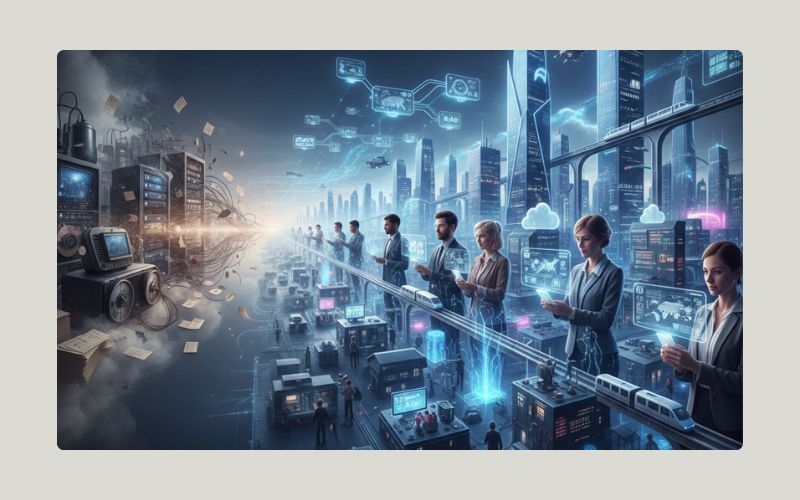
Technology has progressed at an exponential rate over recent decades, fundamentally transforming how people live, work, communicate, and interact with the world. What began with room-sized computers accessible only to large organizations has evolved into a ubiquitous digital ecosystem where billions carry powerful computing devices in their pockets. This technological revolution continues accelerating, bringing changes that would have seemed like science fiction just years ago.
Looking at today’s tech means seeing how it changes people, companies, jobs, cities. Machines do not grow alone – they respond to what humans want, fear, build. Good tools fix actual issues, open doors, help someone move faster through a day.
Out here, tech isn’t just for big teams anymore. What used to sit behind locked doors now fits in someone’s pocket. Power shifted when cloud access spread wide, mixing with free-to-use code and phones that do almost everything. Suddenly, starting up doesn’t demand a mountain of cash. Folks invent things on kitchen tables, share work across continents fast, grow ideas without corporate backing. Distance? Not a wall. Scale comes easier these days, built piece by piece online.
Nowhere is progress clearer than in how gadgets link up. Machines talk to one another, forming webs that do more together than they ever could apart. Take everyday things – fridges, lights, cars – they plug into online streams. Smarts inside software learn patterns, adapt without constant guidance. Trust shifts too, through shared ledgers where records stay fixed once written. When these forces meet, outcomes emerge that surprise even their makers.
Artificial Intelligence and Machine Learning
Artificial intelligence has moved from research laboratories to everyday applications, transforming industries and enabling capabilities previously impossible. AI systems now recognize faces, understand speech, translate languages, drive vehicles, diagnose diseases, and make recommendations with accuracy that matches or exceeds human performance in specific domains.
Machine learning, the subset of AI focused on systems that improve through experience, powers many of the AI applications people encounter daily. Recommendation engines that suggest products, content, or connections learn from user behavior to personalize experiences. Spam filters adapt to new threats, voice assistants understand natural language better over time, and autonomous systems navigate complex environments by learning from data.
From hospitals to banks, machines that learn are at work. Doctors spot issues in scans faster because software highlights concerns. Outcomes get guessed ahead of time when data patterns show what might happen next. Creating new medicines takes less time now with smart simulations running tests. Banks catch suspicious activity before money vanishes into thin air. Assessing who might default on loans happens through hidden signals in behavior. Stock trades execute themselves based on live market shifts nobody sees coming. Stores keep shelves full by guessing demand before it shows up. Prices shift hour by hour depending on how crowded websites feel. Shoppers get replies without talking to a single human being. Factories fix equipment just before parts fail unexpectedly. Cameras scan products nonstop, tossing out anything flawed. Materials move smarter across continents thanks to constant digital oversight.
Not long ago, machines began helping artists see fresh possibilities in visual work. Tools driven by smart systems now draft different page setups, recommend shades that fit together, clean away backdrops from photos, improve picture quality too. Some worry these helpers might take over jobs meant for people who design things. Right now, though, they do well when paired with humans – taking care of repetitive steps so creators can dive into deeper thinking and original ideas only minds can shape.

Cloud Computing Infrastructure
Cloud computing has revolutionized IT infrastructure, enabling businesses to access computing resources on-demand without investing in physical hardware. Rather than maintaining expensive data centers and server farms, organizations can rent exactly the capacity they need, scaling up during peak periods and down during quiet times. This flexibility dramatically reduces costs while increasing agility.
The cloud computing model offers three primary service tiers. Infrastructure as a Service (IaaS) provides virtualized computing resources including servers, storage, and networking. Platform as a Service (PaaS) adds development tools and middleware that accelerate application creation. Software as a Service (SaaS) delivers complete applications accessible through web browsers, eliminating the need for local installation and maintenance.
Cloud platforms have become essential infrastructure for graphic design firms and creative agencies. Cloud-based design tools enable collaboration across distributed teams, with multiple designers working simultaneously on projects from different locations. Cloud storage provides secure repositories for large design files, version control, and client access. Cloud rendering services accelerate processing of complex visual projects.
The transition to cloud computing represents more than technology migration—it requires organizational change. Traditional IT operated through capital expenditures for owned equipment, while cloud computing shifts to operational expenditure for rented services. This change affects budgeting, planning, and staffing. Organizations must develop new skills for cloud architecture, security, and optimization while potentially retiring legacy capabilities.
Digital Design and Visual Technology
The convergence of technology and design has created unprecedented opportunities for visual communication and creative expression. Modern design tools leverage computing power to enable capabilities unimaginable in the pre-digital era. From 3D rendering and animation to interactive experiences and generative design, technology expands the boundaries of what designers can create.
Bangalore graphic design agencies have embraced technological advancement, incorporating cutting-edge tools and techniques into their workflows. These agencies use advanced software for everything from traditional graphic designing to motion graphics, user interface design, and immersive experiences. Technical proficiency combined with creative vision enables them to deliver sophisticated solutions across media and platforms.
Anyone can make sharp visuals today, thanks to simpler tools. Back then, you needed costly programs plus high-end machines just to start. Now, low-cost plans and online services open doors wide. More people trying means sharper contests in talent pools. Yet room grows too – for skilled creators anywhere, no matter their budget or where they live.
Picture worlds where screens reach beyond glass. Digital shapes sit on real streets when you look through a gadget. Games change. Stores shift. Lessons feel different. Places appear like magic as guidance pops up midair. Shut your eyes to the room. Open them inside another world made of code – training, play, ideas live there. Some studios dive into these spaces early. They learn what few understand now, building skills ahead of demand.
Cybersecurity in the Digital Age
The increasing digitization of business and personal life creates expanded attack surfaces for cybercriminals. Cyberattacks have grown in frequency, sophistication, and impact, targeting organizations of all sizes and individuals worldwide. Ransomware locks systems and demands payment, phishing tricks people into revealing credentials, data breaches expose sensitive information, and denial-of-service attacks disrupt operations.
Effective cybersecurity requires layered defenses that protect at multiple levels. Perimeter security tools like firewalls and intrusion detection systems block unauthorized access. Endpoint protection secures individual devices against malware and exploits. Network segmentation limits lateral movement if attackers penetrate outer defenses. Data encryption protects information even if other controls fail.
Picture makers often carry hidden risks. Those sketches hold ideas someone else could steal. Trust means shielding private plans till they’re ready to share. When teams build online, settings must block strangers without slowing progress. People usually make the easiest target in cyberattacks. Instead of breaking through software defenses, clever attackers play mind games – tricking individuals into making dangerous choices. Teaching staff what to watch for can help them push back against such tricks. Machines that act before humans need to decide add another layer of safety.
Mobile Technology and Applications
A single gadget now does what entire drawers of electronics once handled. Most folks carry one everywhere, using it more than any other tool each day. It talks, thinks, snaps pictures, finds directions, plays music – fits right in a coat pocket too. Carrying less gear has opened doors nobody expected at first. Being online wherever you go changes what people do and how companies reach them.
Most people now browse on phones, so making mobile the priority makes sense. Smaller screens mean less room, requiring simpler layouts that still function clearly. Touch controls change how buttons and menus should behave compared to mouse-based systems. Spotty internet connections demand faster loading elements and smarter resource handling. A layout built around small devices often works better everywhere else too. Code written once can stretch from phone to tablet to desktop when done right. Efficiency grows because teams maintain just one version instead of many.
Graphic designing for mobile requires different approaches than desktop-focused design. Smaller screens demand simplified layouts, larger touch targets, and concise content. Vertical orientations become default instead of horizontal. Loading performance becomes more critical with variable mobile connections. Graphic design firms in Bangalore have developed mobile design expertise, creating visual experiences optimized for handheld consumption.
Mobile applications enable capabilities and business models impossible with desktop-only approaches. Location-based services use GPS to provide contextual experiences. Mobile cameras enable augmented reality applications. Push notifications keep users engaged with timely communications. These mobile-specific capabilities create value that designers and developers leverage to build compelling experiences.
Conclusion
Technology’s rapid evolution creates both tremendous opportunities and significant challenges for businesses and society. Staying current requires continuous learning, experimentation, and adaptation. Organizations must balance innovation with stability, adopting new technologies strategically while maintaining reliable operations.
Digiworq Marketing & Technology Solutions brings comprehensive expertise across the technology landscape, helping businesses navigate complexity and leverage technology effectively. By partnering with the best graphic design firms in Bangalore for creative excellence while maintaining deep technical capabilities, Digiworq delivers integrated solutions that
combine strategic thinking, creative execution, and technical implementation. This balanced perspective enables Digiworq to recommend solutions that fit specific business contexts rather than applying one-size-fits-all approaches. Through strategic consulting, creative collaboration, and technical expertise, Digiworq empowers organizations to harness technology’s transformative potential while avoiding common pitfalls.